
Our Quest for Certainty. The Evergreen Sway of Destiny and Fate
A snapshot view on how Destiny and fate have shaped human behavior throughout history, and why these concepts still influence our beliefs and choices.
DESTINOSOPHY
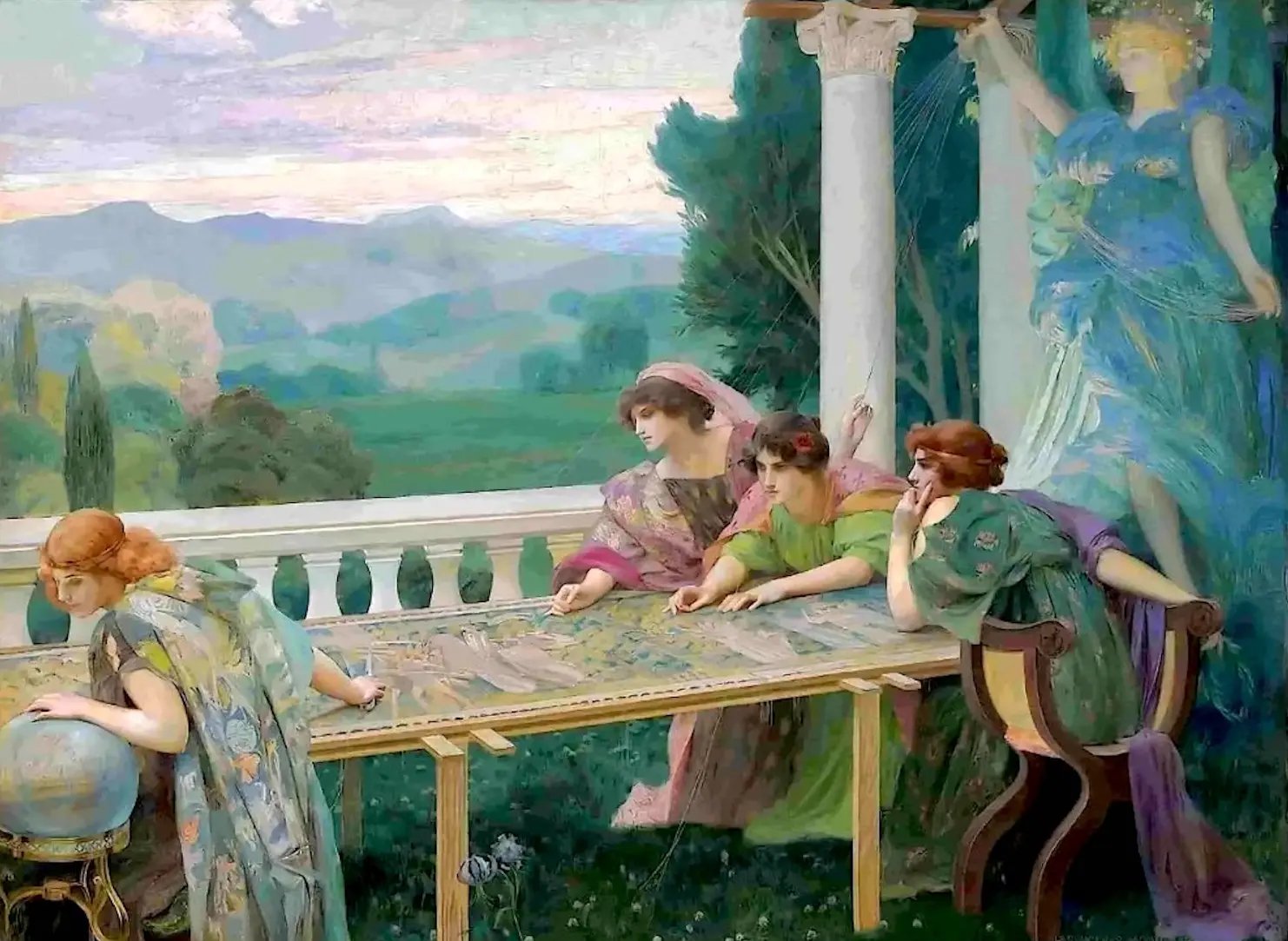

We are living through an era of rarely known uncertainty. Rapid existential trials and collapsing standards, some likely of unmanageable proportions, challenge our ideas and ideals. In such times, our individual and shared global destinies should be at the heart of humanity's future agenda.
But are they? Do many inhabitants of the Global North's fortresses even still embrace the notion of a collective human Destiny? An emerging trend suggests that numbers of even hyper-individualistic paths are now increasingly competing with the big picture of an interconnected world the West promoted, favoring more self-centered philosophical approaches.
Before addressing these questions in an upcoming feature, let's take a look at how the concept of Destiny developed and what it stands for. It’s high time that we get up close with this trailblazing concept's genesis and continued influence on the human experience. And that's just one reason why I've written a book about Destiny* and its connected realms.
Throughout history, countless individuals worldwide, even whole nations, have sought guidance from destiny, fate, and various gods. So why do these concepts still influence our behaviors in good days and bad?
Many of us today still rely on the invisible forces of Destiny, fate, and luck. And we would not be where we are now without our continuous fascination with mythologized and theologized paradigms. Destiny, fate, luck & Co., our formative designers of life, are far from being just ethereal ideations.
Let's examine some of the veiled origins of humanity’s deep relationship with spiritual creeds like Destiny, fate, providence, the many forms of luck, and, of course, free will.
Phenomenal forces as powerful allies
Just like us today, our ancestors craved narratives, mythology, and truth.
The difference? Their plateau wasn’t as softly cushioned as ours. Compared to them, we moderns have access to explanations they could not even dream about. But do we know that much more, though? Likely not, no matter how hard we try to pretend. But at least we can use philosophy and science to better understand the world.
Still, our expectations and egos are somehow different: those oversized chips of entitlement perched on the shoulders of individuals and nations are growing steadily, especially in the so-called Global North. Self-declared exceptionalism, whether personal or national, never works. To me, vainglory is the silly sister of hubris (generally defined as excessive pride and self-regard). Never a good idea. And futile, as history shows clearly.
"Hubris consists in doing and saying things that cause shame to the victim, simply for the pleasure of it. Retaliation is not hubris, but revenge. Young men and the rich are hubristic because they think they are better than other people."
Aristotle, Rhetoric
Looks, sounds, feels strangely current and familiar?
N.B. Dealing with agents of hubris is a storied interest field of a certain extended department of ancient Greek Destiny's special agency, run by Nemesis & Associates.
Returning to our central topic, our existential questions, conflicts, and hopes haven’t changed much. I dare say our fears are much the same as those of our foremothers. What’s changed is our ability to do something about them through greater understanding, more choices, and an abundance of opportunities for direct agency. But many in our modern societies end up too distracted to rise and explore any destinal options, even if just for extra moral courage, let alone multilaterally beneficial consequences. We’re too preoccupied with too much stuff.
And we’re increasingly worried and afraid.
Too many listen to those who impose fear, or know how to lift it. Fear is a colossal impediment and ruthless enabler, a terrifying, yet also healthy, response of the amygdala region in our brains. These fear-wielding experts, dogmatic organizations, and tyrannical forces play both their trepidation-mongering and the deliberately dread-relieving parts to rule supreme.
Why? Because societies allow them to pull grandiose quantities of wool over our collective eyes. No matter how daft or outlandish their promises, they’re still welcomed as comforting poultices for the scraped-raw skin of the human soul.
That can, must, and will change.
What exactly is Destiny?
Destiny is a seminal metaphysical and phenomenal force. Even in their earliest days, our ancestors showed a deep affinity for divine personifications overseeing the ever-unfolding human path. That yearning gave rise to powerful, often feminine, cosmic principles that brought direction, order, and purpose to human life. And attention. As a powerful spiritual phenomenon and, arguably, the original conceptual framework for meaning and purpose, Destiny answers an intrinsic human need.
It helps us transform a massive void into horizon-opening reality, strengthening our sense of meaning and purpose. We experience this grand sense-maker beyond the unproven realms of religious belief, linking cosmic and mental realities with our inner and outer worlds.
Before we examine the significance of spiritual powers like Destiny, Fate, and Luck, let’s take a nano trip down History Lane. When it came to Destiny and fate, the people of our international past trusted a good many splendid deities, of which I'm naming just a few here. Please click on any of the linked terms for more context.
Ancient Greece knew Destiny Goddesses such as Ananke, the primordial top goddess of Necessity and Destiny personified and her still famous Moirai, Destiny's three thread-spinning, -measuring, and -cutting leading ladies.
Their Roman reflections were Necessitas and the three Parcae or Fates, as well as the embodied principle Providentia, the Imperial face of foresight and wisdom.
The kingdoms of Egypt gave us the formidable Shai or Shait, the determiner of the path of life, who manifested in both male and female form.
From Mesopotamia hailed the great council of the Anunnaki, those mighty divisors of all Destiny between the rivers Euphrates and Tigris.
The Scandinavian realms listened to their three Norns Urd, Verdandi and Skuld, the Vikings' awe-inspiring weavers of past, present, and future.
These mythological incarnations** designated, spun, and managed the threads of both divine and human existence. They also looked after early notions of ethics and higher justice.
And all beings, including all other Gods, accepted the cosmic decree of Necessity along the threads of Destiny.
Destiny's divine representatives never really asked for worship. There never existed material interest, or greed for constant validation through pomp and circumstance in its name. Submission, adoration, and prayers weren’t particularly popular with Destiny's deployers. Why? Little point in haggling or seeking appeasement with the arch-mothership, right?
Do people still believe in Destiny?
Absolutely. Excuse my hopping on the ad populum bandwagon here, but international researchers point to the fact that over half of the world's population cherishes a connection to the philosophical or religious expressions of Destiny (decided by the God(s) of their choice or their cultural persuasion or pressure). It works for them through its cosmic order, natural, and even atheistic options, given many names by different global worldviews. Please click on any of the linked terms for more context.
Fatum : Latin for inevitable Destiny: fate
Kismet : Turkish/Arabic for one's lot in life
Tian Ming : Classic Chinese for Confucianism's Heavenly Mandate
Ming : Chinese for celestial individual Destiny as experienced by Confucianism and Daoism thought worlds
Yuan Fen : Mandarin/Chinese for Dao and Buddhist stance on destined relationships in all areas
Rta/Rita : Sanskrit/Indian for the Vedic philosophy of cosmic truth as foundation for Karma and Dharma
Karma : Sanskrit/Indian for self-induced law of cause and effect
Dharma : Sanskrit/Indian for the dutiful moral path
Fortune : original Latin Goddess Fortuna for life-changing luck
Hashgacha : Hebrew for Jewish faith in Hashem's godly providence
Divine Providence : orig. Latin for the Christian idea of God's actively processed will
Al-Qadr : Arabic for the Islamic view on Allah's preordination
Predestination : original Latin for the Christian belief in God's plan for salvation or damnation
Hukam : Arabic/Punjabi for the Sikh notion of divine command
Kami : Japanese for the Shinto credo of spirit beings' life design
Avoš : Russian for the positive attitude that fate will work out well
Why should we explore this legendary power?
The more we understand Destiny, the more we understand ourselves and our place in the universe. That knowledge better equips us to shape the future, both personally and collectively. That way, our choices and actions will transport us to our destinies.
Connecting the dots
Did you know that the ancient notion of a guiding supra-power and the first teleological concept we now call Destiny once sparked global spirituality, including the revered faith systems still with us today? Across beliefs and philosophies, people continue to relate to Destiny as a transcendent and transformative force. We may not always define it, but we can feel its invisible presence.
This ancient principle is in the world's water supply, necessary, subtle, yet all-permeating, and of impressive historical and modern relevance. With so much to discover about this singular supra-force, about its origins, evolution, and enduring presence, the time is now to update our awareness for a meaningful journey.
By Helena Lind┃Independent thinker and author of The Destiny Book : Rediscovering the Mother of Spirituality (History and Mystery of the All-Connecting Cosmic Thread), Identity Publications, 2024. My work draws on decades of comparative study across mythological, philosophical, and theological traditions, informed by lifelong personal experience and bilingual research into Destiny's cross-cultural presence.
*The Destiny Book: Rediscovering the Mother of Spirituality (History and Mystery of the All-Connecting Cosmic Thread) by Helena Lind invites readers on a journey across Destiny's mythical beginnings to today’s enduring significance as a major guiding force. The Destiny Book offers an engaging history of humanity’s relationship with the wellspring of international spirituality.
** Find more information on the many celestial emanations in The Destiny Book's Chapter 2: Destiny and Mythology /Gods of Destiny.
Image credit: Le Destin by Henry Siddons Mowbray, 1886, public domain https://commons.wikimedia.org/wiki/File:Le_destin_Henry_Siddons_Mowbray.jpg
©1994-2026 Helena Lind. All Rights Reserved.