
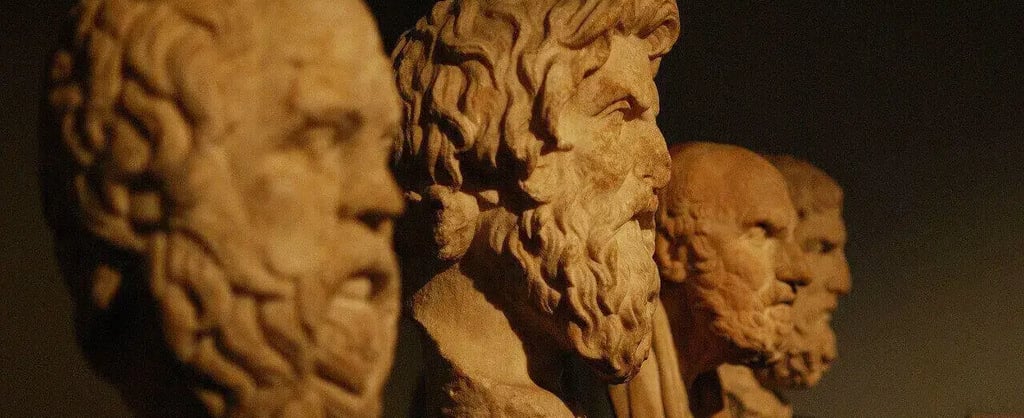
For thousands of years, we've been circling around the same questions about Destiny, fate, and free will. Philosophy sharpens the lens, religion devotes itself to answering, but nobody can claim that they've settled it yet. If they're honest.
This is Part 1 of a light two-part exploration. Here we'll look into a few of the ancient philosophical foundations: what the Greeks and Romans actually said about fate, necessity, and whether we're in control of anything at all. In my follow-up article Free Will or Destiny? How Religion rebranded Ancient Philosophy (Part 2), we'll see how religion adapted these ideas and what that means for us today. This article is but a taster of topics I address in The Destiny Book, where we discover a great deal more about Destiny and philosophy, history, and the first force in the universe. If you're interested in finding out more, please read on here. For a good portion of humanity's existence, the eternal question of whether we sentient beings have a hand in the flow of life has been the subject of curiosity and examination. Several hypotheses and interpretations stem from even more opinions and analyses. While there are fundamental differences, one special theme, seen from two different angles, timelessly stands out.
Let's talk about fatalism
Fatalism is the belief and acceptance that events are inevitable and come to pass regardless of any circumstance. It's a prevalent idea across many cultural perspectives. The term is derived from the Fatae , or the Fates, those three Roman Goddesses of Destiny modeled on the three Greek Moirai. Fatum is Latin for Destiny. Fatum derives from fas, fari, which mean to speak, to predict, and to reveal a hidden truth. Fatum and the Fatae, over time, developed into fate and the fates in English and other languages. Fate is used as an alternative word for Destiny, although fate is often seen as a darker and more unavoidable power. The three lovely fates determined each human's thread of life by designating its portion, spinning each human story, and finally, cutting the cord that represents physical existence. Hesiod's Theogony provides one of the earliest accounts of their Greek blueprints: the Moirai.
And there are no negotiations. No extensions. Not even a customer service chat.
Depending on the point of view, definitions of the driving force that propels the universe differ. In theological fatalism, the original force is channeled to add more power to the toolbox of an omnipotent God figure. Ancient philosophy based the irresistible energy on the principles of Destiny and necessity, the universe, nature, or logical laws. In concert with the design of the fates or Moirai, of course. And then some.
What is logical fatalism?
Originally, fatalism was a mindset that accepted without question that all events in our lives are predecreed and unavoidable. But we want to talk about logical fatalism here. Logical fatalism presupposes all events in our lives occur as a necessity, not because they were predestined by some cosmic force or because of free will, but because they had to occur based purely on logic. The necessity comes from the structure of truth itself. The Stanford Encyclopedia of Philosophy provides a comprehensive overview of this challenging concept. Picture this with a real-life example. If a storm wreaks havoc on Friday, then the statement 'a storm will wreak havoc on Friday' was true even before the storm rolled in. But conversely, the statement 'a storm will not wreak havoc on Friday' was false. If the statement is true, the event will necessarily occur. Not because external forces compel it, but because a true statement cannot be false. Someone is poor because he cannot be rich, or rich because he cannot be poor at that moment. Pure inevitability. The implication is that we, as humans, have no control over our actions and inactions.
Are we sleeping well with that thought though?
Anyway, this rigid bond is not the only view of fatalism, Destiny, and fate, because not everything has to happen because of necessity. At least that's what some philosophers argued.
So what did Aristotle say about all this?
To Aristotle, and a good number of other philosophers, we as humans have control (at least to an extent) over our personal spheres. Our fate is not entirely reliant on a predetermined system based on the law of necessity. Instead, we can act on our own accord. The agency of free will. Aristotle agreed that events, when they happen, are a necessity. Can't argue with that. But he added that not every necessary or unnecessary event eventually plays out in actuality. Whatever happens or doesn't happen can be tied in part to our free will or self-determination. A convenient position, really, when you're trying to hold people morally accountable, no matter what. His famous sea battle argument in De Interpretatione explores these tensions between necessity and contingency.
But then he also wrote:
The truly good and wise man will bear all kinds of fortune in a seemly way, and will always act in the noblest manner that the circumstances allow.
Aristotle, Nicomachean Ethics
Enter Marcus Tullius Cicero
The Greek philosophers like Democritus, Heraclitus, Empedocles, and Aristotle were proponents of 'classical' fate and necessity. Their definitions were summarized but morally rejected by the Roman statesman, author, and orator Cicero in his counter-argument, De Fato:
If all things happen by fate, all things happen with an antecedent cause, and if this is true of desire, it is true also of what follows desire, and therefore true of assent. But if the cause of desire is not within us, desire itself is not in our power, and if this is so, then those things which are brought about by desire are not within us. Therefore, neither assent nor action is in our power; and from this it follows that neither praise nor blame are just, nor honors nor punishment.
Cicero, De Fato
Good friend Cicero remained steadfast. He wouldn't agree to this summary, in which he condensed the opinion of Greece's finest on fatalism. Instead, he insisted that an uninfluenced human freedom of will is a necessity for an ethical life.
Because without it, the entire Roman legal system would look rather silly, wouldn't it?
If Cicero's take on human liberty is true, it would render both philosophical and theological fatalism somehow irrelevant, including the decreeing agencies of fate and any omniscient God(s).
But is it, Plato?
Man never legislates, but destinies and accidents, happening in all sorts of ways, legislate in all sorts of ways.
Allow me to briefly revisit what the ancient Greeks thought about wo(men) and their destinies.
Destiny controlled all aspects of the universe. Even their legendary heroes avoided fighting the callers of all shots to not be perceived as cowards since the highest moral courage had to be mustered to harmonize our ambitions with the cosmic plan. A hero(ine) was someone who accepted their Destiny, whatever it meant, period.
Helena Lind, The Destiny Book* (Chapter 4: Affiliated Destinal Agencies)
Where this leaves us
So ancient philosophy gave us a fascinating conundrum. Logical fatalism says everything happens by necessity based on truth itself. Plato suggests destiny and accidents run the show regardless. Aristotle tries to wedge in some room for human agency. Cicero insists we must have free will or morality collapses. None of them could prove their position. Yet all of them shaped how we think about fate and choice today. Maybe, all glorious three of them have a point?
In Part 2, we'll see how later thinkers, particularly theologians, tried to reconcile an all-knowing God with human free will. Spoiler: it gets even more interesting but also increasingly complex.
By Helena Lind┃Independent thinker and author of The Destiny Book : Rediscovering the Mother of Spirituality (History and Mystery of the All-Connecting Cosmic Thread), Identity Publications, 2024. My work draws on decades of comparative study across mythological, philosophical, and theological traditions, informed by lifelong personal experience and bilingual research into Destiny's cross-cultural presence.
*The Destiny Book: Rediscovering the Mother of Spirituality (History and Mystery of the All-Connecting Cosmic Thread) by Helena Lind invites readers on a journey across Destiny's mythical beginnings to today’s enduring significance as a major guiding force. The Destiny Book offers an engaging history of humanity’s relationship with the wellspring of international spirituality.
©1994-2026 Helena Lind. All Rights Reserved.